A bad week can make you feel like you have lost control of your entire routine. Maybe you stopped exercising, slept at odd hours, spent too much time on your phone, missed important work, or simply lost the energy to do the things you normally care about.
Then comes the frustrating part: you know you need to get back on track, but you don’t know where to begin.
If you are wondering how to rebuild your routine after a bad week, don’t try to fix your entire life in one day.
Start by accepting what happened, return to a few basic habits, remove the biggest distractions, and take small actions consistently. You don’t need a perfect comeback. You need a realistic restart.
Honestly, I have had bad weeks too. And I have learned that the fastest way forward is not spending all day thinking about how badly things went. It is slowly getting you moving again.
Why Does One Bad Week Make It So Hard to Get Back on Track?
One bad week can affect much more than your schedule. When your sleep becomes irregular, your energy changes. When you stop exercising, you may feel less active. When unfinished work starts piling up, even simple tasks can feel heavy.
Then there is the mental side of it.
You start thinking, “I wasted this whole week,” or “I will start properly from Monday.” Sometimes you even compare your current self with the person you were when everything was going well.
That comparison can make restarting harder.
The truth is that one bad week does not erase all the progress you made before it. You may have lost momentum, but you have not necessarily lost everything you built.
I personally noticed that when something goes wrong, or I fail at something, my mind naturally starts thinking about my dreams and the life I want to build. I know I have failed many times, but those failures have also taught me how to get back up.
You don’t need to pretend that the bad week didn’t hurt. You just don’t need to let it become your identity.
How to Rebuild Your Routine After a Bad Week Without Feeling Overwhelmed?
The best way to rebuild your routine is to make it smaller before you make it bigger. Instead of trying to restart every habit at once, choose a few basics that give your day some structure.
Fix your sleep, complete one important task, move your body, reduce distractions, and gradually add the rest of your routine back.
The biggest mistake is trying to compensate for lost time.
Imagine you missed five workouts. You suddenly decide to exercise for two hours every day. You have ten unfinished tasks, so you create a huge to-do list.
You spent too much time on your phone, so you decide you will never touch it again.
It sounds productive, but it often creates more pressure.
Instead, ask yourself, “What are the few things that would make tomorrow better?”
For me, that might mean getting back to my work, doing some exercise or yoga, spending a little time in meditation, and giving myself some quiet time to think.
You can also use a simple rule: restart one habit before adding another.
If you stopped exercising, start with a 10–20 minute walk. If your work routine disappeared, start with one focused session. If your sleep schedule is messy, first work on having a more consistent wake-up time.
Small actions may look insignificant when you are thinking about your dream life, but they are often how you actually move towards it.
How to Get Back on Track After a Bad Week When You Have Lost Your Motivation?
You don’t always need motivation to restart. Sometimes you need to start first and allow motivation to catch up later.
There have been times when I have felt low after something went wrong. During those moments, I don’t always try to force myself to be positive.
If I feel like crying, I let myself cry. I talk to God and say whatever is going on in my mind. Sometimes I simply need to let those emotions out.
And then I try to move.
I might dance for a little while, exercise, do yoga, meditate, or simply return to my work. It doesn’t magically solve everything, but it changes my direction.
That is an important difference.
You don’t have to feel amazing before you take action.
If your motivation is low, make the first action almost ridiculously easy. Open your laptop and work for five minutes. Put on your shoes and walk outside. Clean one small part of your room. Write down the one task that actually matters today.
Once you begin, continuing often becomes easier.
Another thing that helps me is remembering why I started. I think about the kind of life I want to create and the person I want to become.
I know there will be difficult days, but I also know that giving up completely will not take me where I want to go.
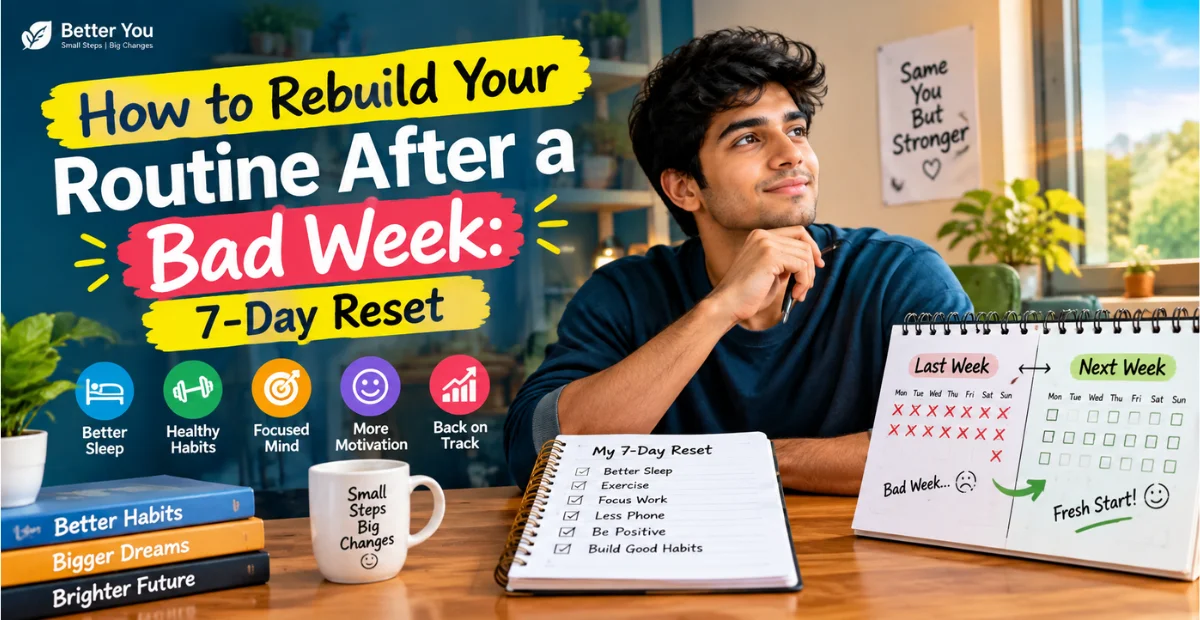
How to Reset Your Routine After a Bad Week With a Simple 7-Day Plan?
You don’t need a complicated productivity system to reset your routine. Give yourself one week to gradually bring back the basics instead of expecting yourself to become extremely productive overnight.
On Day 1, stop the spiral. Take a shower, clean your space, eat properly, and decide what actually needs your attention.
On Day 2, focus on your sleep and morning. Don’t worry about creating a perfect 5 AM routine. Just try to wake up at a reasonable, consistent time and start your day without immediately disappearing into your phone.
On Day 3, complete one meaningful task. It could be work, studying, writing, applying for a job, or anything important to your current goals. One completed task is better than a giant list of unfinished ones.
On Day 4, bring movement back. Walk, run, stretch, work out, or practise yoga. You don’t have to punish yourself for missing exercise.
On Day 5, look at your biggest distraction. For many people, including me sometimes, the phone can quietly take hours from the day. Turn off unnecessary notifications and create some distance between yourself and the screen.
On Day 6, increase your focused work gradually. If you can comfortably work for 25 minutes, start there. You don’t need to prove anything by forcing yourself into a four-hour deep-work session.
On Day 7, look back at the week. Ask yourself what helped, what distracted you, and what you actually want to continue.
The goal isn’t to become a completely different person in seven days. The goal is to feel like you are driving your own day again.
How to Stop One Bad Week From Turning Into a Bad Month?
You cannot prevent every bad day. Life will interrupt your plans. You will sometimes get tired, disappointed, distracted, or overwhelmed. The important thing is learning how to return instead of expecting yourself never to fall off track.
One strategy I find useful is having a minimum version of your routine.
On a normal day, you might exercise for 45 minutes, work for several hours, read, meditate, and complete everything on your list.
But on a difficult day, your minimum routine could simply be getting enough sleep, taking a short walk, completing one important task, and taking care of yourself.
This gives you somewhere to return to.
Good friends also matter. Life already has enough negativity, so surrounding yourself with supportive people and enjoying time with good friends can make difficult periods feel lighter. You don’t have to spend every moment thinking about your problems.
One thing I have learned is that the more you constantly replay a bad period in your head, the bigger it can feel. At some point, you have to let the old day stay in the past and start rebuilding.
I also remind myself that pressure can be a privilege. It means there is something I care about enough to work towards. My mindset has gradually become simple: today’s effort can create tomorrow’s comfort.
You don’t need to romanticise struggle, but you also don’t need to run from every difficult period. Sometimes the difficult season teaches you how to become more resilient.
How do I get back into a routine after a bad week?
Start small. Choose a few basic habits, such as a consistent wake-up time, one important task, some movement, and less unnecessary screen time. Once those become manageable again, gradually rebuild the rest of your routine.
How long does it take to get back into a routine?
There is no universal number of days. It depends on how disrupted your routine became, your habits, your environment, and how consistently you practise them. Focus on returning to the basics rather than worrying about an exact deadline.
What should I do if my entire routine has fallen apart?
Don't rebuild everything simultaneously. Identify the two or three things that matter most right now and start there. Once your days become more stable, add other habits gradually.
Conclusion
A bad week does not mean you are back at zero. It simply means you need to pause, reset, and start moving again.
If you want to know how to rebuild your routine after a bad week, remember that progress often begins with one ordinary decision: getting up and trying again.
Take one small step today, explore the other helpful self-improvement articles on this blog, and share your experience in the comments. Subscribe for more practical ideas to help you keep moving forward.

 One bad week can affect much more than your schedule. When your sleep becomes irregular, your energy changes. When you stop exercising, you may feel less active. When unfinished work starts piling up, even simple tasks can feel heavy.


