
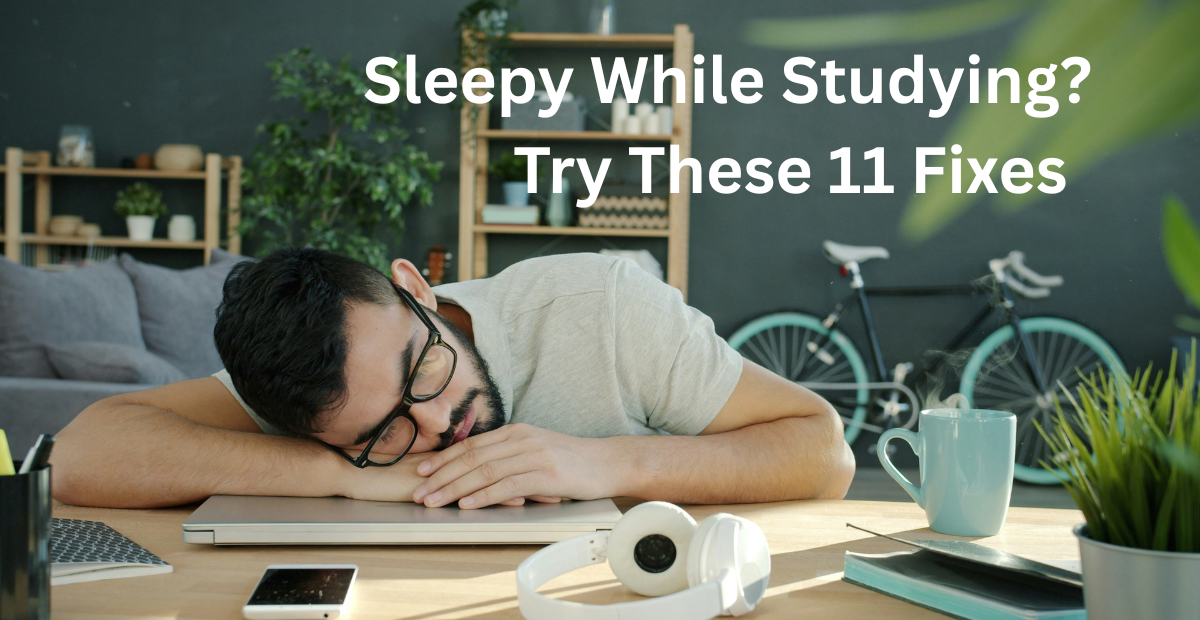
You sit down to study with a clear plan. Your book is open, your notes are ready, and you genuinely want to focus.
Then, after reading a few pages, your eyes start feeling heavy.
You yawn. You read the same sentence again. Your mind starts wandering. Five minutes later, you’re thinking about lying down “just for a minute”.
If this sounds familiar, you’re not necessarily lazy or lacking discipline. Feeling sleepy while studying can happen because of insufficient sleep, long passive study sessions, an uncomfortable study environment, distractions, stress, or simply studying at a time when your body is naturally tired.
The good news is that you don’t always need more motivation. Sometimes you need to change how, where, and when you study.
In this guide, I’ll show you what to do if you feel sleepy while studying, how to stay more alert during study sessions, what to do when studying at night, and when constant sleepiness may be a sign that you need to look beyond your study routine.
Feeling Sleepy While Studying? Try These 11 Fixes
If you’re getting sleepy right now, don’t keep staring at the same page and hoping your concentration magically comes back.
Try one or two of these changes first.
1. Get Up and Move for a Few Minutes
When you’ve been sitting in the same position for a long time, getting up can be a simple way to reset your attention.
You don’t need a full workout.
Walk around your room, stretch your legs, roll your shoulders, or do a few light movements. The goal is simply to stop sitting completely still.
I personally found short movement breaks much more useful than forcing myself through a study session when my concentration had already dropped.
After moving, come back and start with one small task instead of telling yourself you have to study for another three hours.
2. Stop Studying on Your Bed
Your study environment matters more than you may realise.
If you’re lying on your bed with a book or laptop, you’re making it very easy for your body to switch into relaxation mode.
Instead, use a chair and desk whenever possible.
Keep your back reasonably upright, put your study material in front of you, and create a setup that feels like a place for learning rather than sleeping.
If your room has very low lighting, improve the lighting too. A comfortable but dim environment can make it harder to stay alert.
3. Use Short, Planned Study Sessions
One of the biggest mistakes I used to make was believing that serious studying meant sitting for two or three hours without stopping.
It didn’t work for me.
After a while, I was physically sitting with my book but mentally somewhere else.
I eventually started using shorter sessions—around 30–40 minutes—with brief breaks in between. I would walk around, stretch, or drink some water before starting again.
That small change made studying feel much more manageable.
You can also try the familiar 25-minute study + 5-minute break approach.
The exact number isn’t magic. The important part is creating a defined period of focused work instead of an endless session.
4. Make Your Studying Active
If you’re only reading the same pages again and again, your study session can become mentally dull.
Instead of asking:
“How long have I been studying?”
Ask:
“What am I actually doing with the information?”
Try:
- Explaining the topic in your own words
- Solving practice questions
- Writing short notes from memory
- Creating questions about what you just learned
- Teaching the concept to someone else
- Closing your book and recalling the main points
For example, after reading a chapter, close the book and ask yourself:
“Can I explain what I just learned without looking?”
If you can’t, go back, review the difficult part, and test yourself again.
This gives your brain a task instead of asking it to simply stare at words.
5. Keep Your Phone Away From Your Study Area
Sometimes the problem isn’t that you’re physically sleepy.
You’re simply finding normal studying extremely boring compared with your phone.
If you spend your break watching short videos, checking notifications, replying to messages, and jumping between apps, returning to a textbook can feel unusually difficult.
I noticed this myself during exam preparation. On days when I spent too much time switching between apps, getting into a focused study session felt much harder. When I kept my phone away for a while, starting became easier.
You don’t have to quit your phone completely.
Before studying, try this:
Put your phone on Do Not Disturb → keep it away from your desk → start your timer → study one topic.
If you need your phone for study material, remove unnecessary notifications and keep only the resources you actually need open.
6. Drink Water and Don’t Study After a Very Heavy Meal
Dehydration can contribute to feeling tired, while a very heavy meal may leave some people feeling sluggish.
So keep water near your desk and pay attention to how you feel after different meals.
If you regularly become extremely sleepy after a large lunch, experiment with a lighter meal before your next study session.
You don’t need a complicated “brain food” routine.
Start with basics:
- Drink water regularly.
- Eat balanced meals.
- Avoid overeating immediately before studying.
- Notice which foods make you feel sluggish.
The goal is to make studying easier, not to follow another complicated routine.
7. Change the Type of Task When Your Attention Drops
Sometimes you aren’t completely exhausted—you’re just mentally bored with the same type of work.
I’ve experienced this during long study sessions.
If reading theory started making me sleepy, I would switch to solving questions or revising notes. The change gave me something different to actively work on.
You can use the same idea:
Reading → questions
Theory → practice
Watching a lecture → writing notes
Memorising → self-testing
This doesn’t mean constantly jumping between unrelated subjects. It means changing the type of mental activity when one approach stops working.
8. Take a Short Break Instead of Fighting Sleep
There’s a difference between a small dip in attention and genuine sleepiness.
If you’re yawning constantly, struggling to keep your eyes open, and repeatedly rereading the same sentence, forcing yourself to continue may not be productive.
Take a short break.
Stand up. Walk around. Drink water. Stretch. Look away from your study material.
Then return and try another focused session.
If you’re genuinely sleep-deprived, however, a break isn’t a substitute for sleep. Repeatedly cutting your sleep to study longer can eventually make studying less effective.
9. Study With Someone When You Struggle to Stay Accountable
Studying alone isn’t the best option for everyone.
If you constantly lose focus when you’re alone, try studying alongside a friend who is also serious about working.
You don’t even have to discuss the same subject.
You can agree:
“Let’s study for 30 minutes without talking, then take a five-minute break.”
The other person creates a little accountability.
Just make sure your “study partner” doesn’t become a two-hour conversation.
10. Choose Your Study Time More Carefully
You don’t have to force yourself to do your hardest subject at the time when you feel the most tired.
Pay attention to your own pattern.
Maybe you think more clearly in the morning.
Maybe you’re more productive in the evening.
Maybe you struggle badly after lunch but feel better later.
For a week, notice:
- When you feel most alert
- When you become sleepy
- Which subjects require the most concentration
- When you usually reach for your phone
Then place your hardest subjects during periods when you’re naturally more alert and leave lighter tasks for lower-energy periods.
11. Fix Your Sleep Instead of Trying to Defeat It
This is the most important fix if you’re regularly sleeping too little.
If you stay awake late every night, wake up early, and then expect yourself to concentrate for hours, your study problem may actually be a sleep problem.
For adults aged 18–60, the CDC recommends at least 7 hours of sleep per night. Teenagers generally need more—around 8–10 hours.
So don’t treat sleep as wasted study time.
Good sleep is part of your study routine.
If you constantly need to fight sleep just to finish your study target, your schedule may need changing.
Why Do I Feel Sleepy While Studying?
There isn’t always one single reason.
Sometimes the answer is obvious: you didn’t sleep enough.
Other times, the real problem is your study method, environment, timing, or mental state.
Here are some common possibilities.
You’re Not Getting Enough Sleep
This is the first thing to check.
If you regularly sleep late, wake up early, or keep changing your sleep schedule, it’s difficult to expect consistent concentration during the day.
Don’t try to solve chronic sleepiness with another cup of coffee or by forcing yourself to sit longer.
Look at your sleep schedule first.
Your Study Method Is Too Passive
Reading can be useful, but reading the same material repeatedly for a long time can become monotonous.
If you’re highlighting everything, rereading paragraphs, or staring at notes without testing yourself, your attention may start drifting.
Make the session interactive.
Ask questions.
- Recall information.
- Solve problems.
- Explain concepts.
- Write from memory.
Your Study Environment Is Making You Comfortable
A soft bed, dim lighting, lying down, warm blankets, and a phone within reach are not exactly a recipe for alert studying.
Create a clear difference between your study environment and your sleep environment.
A desk and chair can become a simple signal that it’s time to work.
You Just Ate a Very Heavy Meal
If you regularly feel sluggish after a large meal, don’t schedule your most difficult study session immediately afterwards.
Give yourself some time and choose a lighter option when appropriate.
The exact effect varies from person to person, so pay attention to your own response instead of following a one-size-fits-all food rule.
You’re Mentally Tired
Sometimes your body isn’t desperate for sleep—your mind is simply overloaded.
Exam pressure, unfinished assignments, anxiety about results, family problems, or constant overthinking can make it difficult to concentrate.
You may sit with a book while your mind is processing ten other things.
In that situation, taking five minutes to write down what is bothering you can be more useful than forcing yourself to reread the same paragraph.
You’re Constantly Switching Your Attention
Every notification creates another reason to stop.
You check one message.
Then another.
Then a video.
Then you return to your book.
The result is a study session that feels much longer than it actually was.
Remove distractions before you start instead of relying entirely on willpower. Practical study guidance also commonly recommends reducing digital distractions and creating a focused environment before beginning.
What to Do If You Feel Sleepy While Studying at Night
Night studying can feel peaceful because there are fewer distractions.
But there’s a catch.
If your body is already preparing for sleep, staying at your desk for another three hours doesn’t automatically mean you’ll learn more.
I remember studying late at night during exam preparation. Around 1 AM, I realised I had been looking at my material for almost an hour without remembering much of what I’d read.
That was an important lesson for me:
Being awake is not the same as learning effectively.
If you need to study at night, try this:
Keep Your Study Area Bright
Don’t study in a dark room with only your laptop or phone illuminating your face.
Use comfortable, adequate lighting so your workspace doesn’t feel like a place for sleeping.
Don’t Study on Your Bed
Keep your bed for sleep whenever possible.
Use a desk, chair, library, or another dedicated study area.
Keep the Session Short
Instead of thinking:
“I have to study until 2 AM.”
Think:
“I’ll do one focused 25-minute session.”
Then reassess.
Switch to Active Work
If reading is making you sleepy, solve questions, write answers, make flashcards, or explain the material aloud.
Keep Water Nearby
Having water within reach gives you an easy reason to take a brief pause without opening social media.
Don’t Sacrifice Sleep Every Night
One late-night session before an important exam is different from regularly sleeping too little.
If your study schedule requires you to stay awake far beyond your normal bedtime every day, the schedule itself needs attention.
How to Study Without Feeling Sleepy
The goal shouldn’t be to find a trick that keeps you awake forever.
The better goal is to make your study sessions engaging enough, structured enough, and sustainable enough that you’re not constantly fighting your body.
Try this simple system.
Step 1: Decide One Specific Task
Don’t write:
“Study biology.”
Write:
“Finish the first two sections of Chapter 4 and answer 10 practice questions.”
A specific target makes starting easier.
Step 2: Remove Distractions
Put your phone away.
Close unnecessary browser tabs.
Keep only the material you need.
Step 3: Start a Timer
Try 25 minutes.
If you’re having a particularly difficult day, even starting with 10 minutes is better than spending 30 minutes preparing to study.
Step 4: Study Actively
Don’t just read.
Question yourself.
Write.
Solve.
Recall.
Explain.
Step 5: Take a Real Break
Stand up.
Walk.
Stretch.
Drink water.
Don’t automatically replace your study session with a 20-minute social media session.
Step 6: Start Again
After your break, repeat the process.
Over time, you’ll learn which session length works best for you.
Check right now: time management for students
What Not to Do When You’re Sleepy While Studying
Sometimes avoiding the wrong response is just as important as knowing the right one.
Don’t Keep Rereading the Same Page
If you’ve read the same paragraph three times and still don’t remember it, change your approach.
Ask questions or explain the concept instead.
Don’t Study Lying Down
If your body is comfortable enough to sleep, staying awake becomes unnecessarily difficult.
Don’t Make Caffeine Your Main Strategy
Coffee or tea may make you feel more alert temporarily, but they aren’t a replacement for adequate sleep.
If you’re repeatedly exhausted, fix the underlying routine instead of continually trying to cover it up.
Don’t Spend Every Break Scrolling
A five-minute break can easily become thirty minutes when you open social media.
Make your break physically refreshing rather than mentally noisy.
Don’t Compare Your Study Hours With Social Media
Someone else’s “12-hour study routine” tells you very little about how effectively they actually learnt.
Three focused hours can be more valuable than sitting with a book for eight distracted hours.
What If You’re Still Sleepy Even After Sleeping Enough?
This is where you should stop assuming that the problem is simply laziness or poor discipline.
If you’re regularly getting enough sleep but still experience excessive daytime sleepiness, especially if it interferes with school, college, work, or everyday activities, consider talking to a healthcare professional.
Persistent daytime sleepiness can sometimes be associated with sleep disorders or other health issues. For example, sleep apnea can cause daytime sleepiness and problems with attention or concentration.
You don’t need to diagnose yourself.
Just pay attention to persistent symptoms and seek appropriate medical advice when necessary.
A Simple 2-Hour Study Plan for When You’re Feeling Sleepy
If you don’t know what to do the next time you sit down and immediately feel sleepy, try this structure.
0:00–0:05 — Reset
- Drink some water
- Put your phone away
- Clear your desk
- Sit upright
- Decide exactly what you’ll study
0:05–0:30 — Focused Study
Study one specific topic.
Don’t switch between five different subjects.
0:30–0:35 — Movement Break
Stand up.
Walk around.
Stretch.
Avoid opening social media.
0:35–1:00 — Active Recall
Close your notes and test yourself.
Write down what you remember or solve practice questions.
1:00–1:10 — Longer Break
Move around, drink water, and reset.
1:10–1:35 — Second Study Block
Continue with another topic or the next part of the same chapter.
1:35–1:40 — Short Movement Break
Get away from the desk for a few minutes.
1:40–2:00 — Revision
Review what you learned.
Ask yourself:
What did I learn?
What can I explain without looking?
What do I still need to revise tomorrow?
This gives you a clear ending instead of sitting at your desk until you become too tired to remember anything.
What to Do If You’re Falling Asleep Right Now
If you’re literally struggling to keep your eyes open, don’t spend another 20 minutes fighting the textbook.
Try this quick reset:
Get up → walk for a few minutes → drink some water → move to a bright desk → put your phone away → start one short active study session.
If you’re genuinely sleep-deprived, however, the better answer may be to sleep and study after you’ve rested.
The goal isn’t simply to stay awake.
The goal is to learn.
Check right now for the best, most interesting, and most educational blog article: 7 powerful goal-setting examples
Frequently Asked Questions
Why do I feel sleepy while studying even after sleeping well?
Adequate sleep doesn't automatically guarantee perfect alertness during every study session. Passive studying, long sessions, a comfortable environment, stress, distractions, meal timing, and studying during your natural low-energy period can all make concentration harder.
How do I stop feeling sleepy while studying for exams?
Start by protecting your sleep. During study sessions, use shorter focused blocks, take movement breaks, keep your phone away, study at a desk, and use active recall instead of only rereading notes. Avoid turning every night into an all-nighter.
How can I study at night without feeling sleepy?
Use a well-lit study area, avoid studying in bed, keep sessions structured, take short movement breaks, drink water, and switch from passive reading to active tasks when your attention drops. But if you're consistently exhausted late at night, moving your study time earlier may be more effective than repeatedly fighting sleep.
How many hours should I sleep if I'm a student?
Sleep needs depend partly on age. The CDC recommends around 8–10 hours for teenagers, while adults aged 18–60 generally need at least 7 hours per night.
Does studying on the bed make you more sleepy?
It can. A bed is strongly associated with rest and sleep, so studying there may make it harder for some people to stay alert. A desk, chair, library, or other dedicated study space can create a clearer boundary between studying and sleeping.
Conclusion
I used to think that feeling sleepy while studying meant I needed more discipline.
But after struggling with long study sessions myself, I realised the problem wasn’t always motivation. Sometimes I was simply studying for too long, studying too passively, staying up too late, or giving my phone too much attention.
Once I started breaking my sessions into smaller blocks, moving around during breaks, changing the type of task, and paying more attention to my sleep routine, studying became much easier.
So the next time you feel sleepy while studying, don’t immediately call yourself lazy.
First, ask yourself:
- Did I sleep enough?
- Am I studying actively?
- Is my environment helping me stay alert?
- Is my phone distracting me?
- Do I need a short break—or do I genuinely need sleep?
Fix one thing at a time.
You don’t need to study for 12 hours to become a better student. You need to make the hours you do study more focused, sustainable, and useful.
And sometimes, the smartest study decision isn’t forcing yourself to keep reading.
It’s knowing when to reset and when it’s time to sleep.
Read more: Hustel With Abhi
✨ Join 10k+ readers for free tips!
Subscribe & never miss a post 📩