
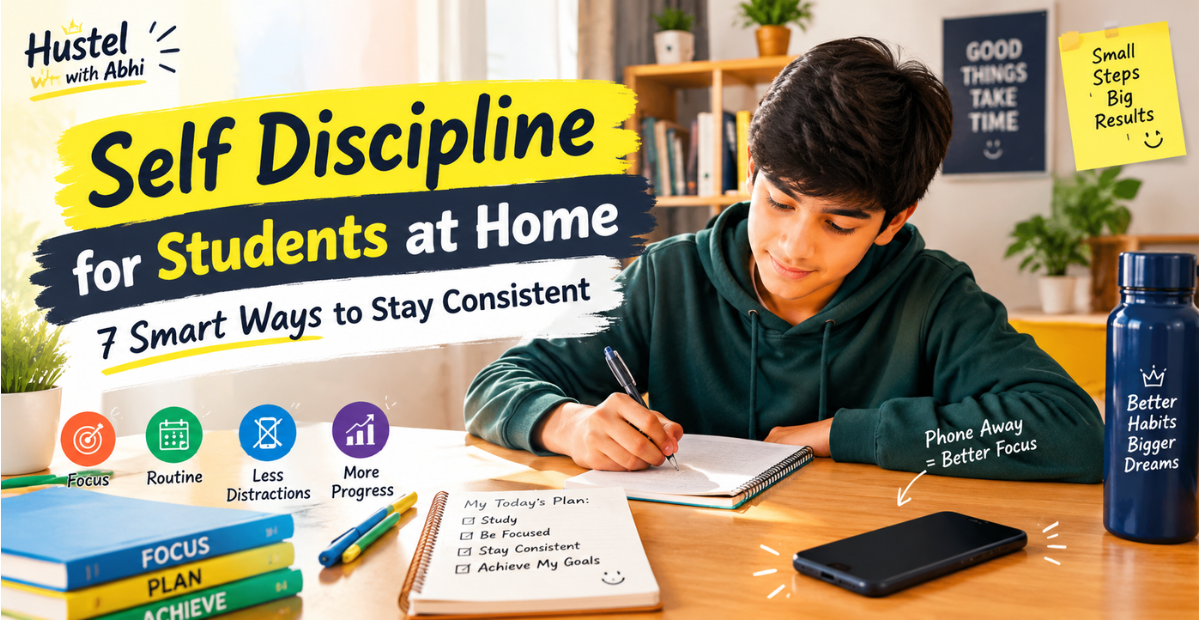
Studying at home sounds easy until you actually have to do it.
There is no teacher standing near you, no classroom bell telling you when to start, and nobody checking whether you are actually studying or just watching one more YouTube video.
Your books are right there, but so is your phone, bed, gaming, Instagram, and every other distraction.
This is why self discipline for students at home is less about being extremely motivated and more about learning how to manage yourself when nobody is watching.
I learned this the hard way. I used to make proper timetables, feel productive after creating them, and then struggle to follow them the next day. Eventually, I realized that I didn’t need a perfect schedule. I needed a simple system that I could actually repeat.
If you are struggling with consistency, procrastination, or studying at home without someone pushing you, these are the strategies that helped me most.
Why Is Self Discipline So Hard for Students at Home?

The biggest problem with studying at home is that your environment gives you too many choices.
You can study, scroll your phone, lie down for five minutes, reply to a message, watch a video, or tell yourself that you’ll start after lunch.
And once you keep delaying the first task, the guilt starts growing.
This doesn’t automatically mean you’re lazy. Self-regulated learning involves planning, managing effort, monitoring your progress, and adjusting your approach when something isn’t working.
Recent research has also linked these skills, including time management and effort regulation, with lower academic procrastination and better academic outcomes.
So instead of asking, “How can I become more disciplined?” try asking:
“How can I make studying easier to start and easier to repeat?”
That small change in thinking can make a big difference.
7 Practical Ways to Build Self Discipline for Students at Home
1. Stop Waiting for Motivation to Study
One of the biggest mistakes students make is waiting until they feel motivated.
I used to do this too. I would think, “I’ll study properly when I feel focused.” But that feeling doesn’t always come.
Motivation can help you start, but you can’t depend on it every day.
Instead, create a simple rule:
When it’s study time, I start—even if I don’t feel like it.
You don’t have to promise yourself three hours of studying. Just sit down and begin.
Sometimes discipline starts with doing something small while your brain is still saying, “Not now.”
2. Use the 5-Minute Start Rule
This is one of the simplest techniques that worked for me.
Whenever a task felt difficult, I stopped telling myself that I had to finish everything. I only told myself:
“I’ll do this for five minutes.”
Open the book. Read one page. Solve one question. Write the first paragraph.
That’s it.
The goal isn’t to finish the whole task in five minutes. The goal is to overcome the resistance to starting.
Once you begin, continuing often feels easier than starting.
This is especially useful when you’re procrastinating because the task looks too big.
3. Keep Your Phone Away During Deep Study
If your phone is besides your notebook, you’re making discipline harder than it needs to be.
I personally found it much easier to focus after turning off unnecessary notifications and keeping my phone away while working.
Try putting your phone in another room or somewhere you cannot easily reach it.
Then study for 25 minutes without checking it.
After that, take a short break and repeat.
You don’t need to study for five hours to prove that you’re disciplined. A few genuinely focused sessions can be much more useful than sitting at your desk for hours while constantly checking your phone.
4. Don’t Build a Perfect Timetable—Build a Repeatable Routine
I was once obsessed with timetables.
I would make colourful schedules, divide the whole day into different tasks, and feel like I had finally fixed my life.
The problem?
Following the timetable was much harder than making it.
So I changed my approach.
Instead of planning every minute, decide on a few fixed things:
- When will you wake up
- When your first study session starts
- What your most important study task is
- When you’ll take breaks
- When will you stop studying for the day
That’s enough to create structure.
Your study discipline at home becomes much easier when your brain doesn’t have to decide from scratch every morning what it should do.
5. Choose Three Important Tasks Each Day
A huge to-do list can make studying feel overwhelming.
Instead, before going to sleep, write down the three most important academic tasks for tomorrow.
For example:
- Finish two mathematics topics.
- Revise biology notes.
- Solve 20 practice questions.
If you complete those three, your day has already moved forward.
You can always do more if you have the energy, but don’t make your entire day depend on completing fifteen tasks.
Planning and self-monitoring are important parts of self-regulated learning, and students can adjust their strategies when their original plan isn’t working.
6. Create a Study Environment That Makes Distraction Harder
Your study environment matters.
If you are studying on your bed with your phone beside you and YouTube open in another tab, you’re constantly fighting distractions.
Instead, create one simple study spot.
It doesn’t need to look like a fancy Pinterest study room. You just need a reasonably quiet place with your books, notebook, water, and whatever you actually need.
When possible, use the same place for studying regularly. Over time, it can become easier to mentally switch into “study mode” when you sit there.
Research on self-regulated learning also highlights environment structuring and a conducive, relatively quiet study space as useful parts of managing learning effectively.
7. Learn How to Restart After a Bad Day
This might be the most important part of discipline.
You will have bad study days.
You might wake up late, waste two hours scrolling, miss your planned session, or procrastinate until the evening.
Don’t turn one bad day into a bad week.
I have done this myself. When I missed my routine, it was tempting to think, “I’ll start properly tomorrow.” But that mindset can keep you stuck.
Instead, restart with the next available block.
If you wasted the morning, study in the afternoon.
If you wasted the afternoon, do one focused session at night.
Self-discipline isn’t breaking your routine. It’s getting back to it.
Don’t Ignore Sleep and Your Energy
Discipline isn’t only about forcing yourself to sit with a book.
If you’re constantly sleeping late and trying to study while exhausted, your routine becomes much harder to maintain.
For students, sleep is connected with well-being and academic functioning, and recent recommendations continue to emphasise healthy sleep as an important part of adolescent health.
So don’t treat sleep as wasted study time.
A student who sleeps reasonably well, moves during the day, eats properly, and studies with a clear plan has a much better foundation for consistency than someone trying to survive on late-night motivation.
What to Do When You Keep Procrastinating
If you repeatedly avoid studying, don’t just call yourself lazy.
Ask what you’re actually avoiding.
Is the chapter too difficult?
Are you afraid you won’t understand it?
Is the task too large?
Are you distracted by your phone?
Are you trying to study for too long?
Sometimes procrastination is a sign that your task needs to be made smaller or clearer.
For example, instead of saying:
“I need to study physics.”
say:
“I will solve the first five questions from Chapter 3.”
Now your brain knows exactly what “starting” means.
That is one of the easiest ways to learn how to stay disciplined while studying without relying on motivation every time.
A Simple Self-Discipline Routine for Students
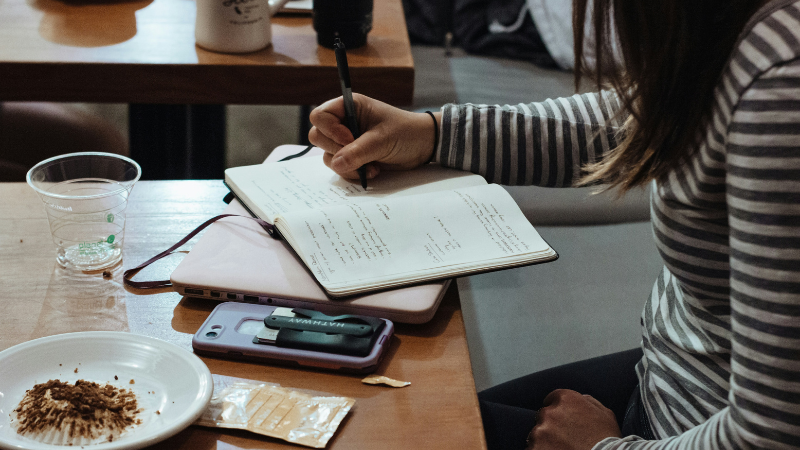
If you don’t know where to start, try this simple system for one week:
Morning: Choose your three important tasks.
Study Session 1: 25 minutes of distraction-free study.
Short Break: Get up, drink water, stretch, or walk around.
Study Session 2: Another 25-minute focused session.
Afternoon/Evening: Complete your remaining important task or revise what you studied.
Night: Check what you completed and write tomorrow’s three priorities.
Don’t worry about making this perfect.
The goal is to prove to yourself that you can follow a simple system repeatedly.
How can I build self discipline for students at home?
Start small. Set a fixed study time, remove obvious distractions, choose three important tasks, and use short focused study sessions. Consistency matters more than trying to completely change your routine overnight.
How do I stop procrastinating while studying?
Make the task smaller and easier to start. Instead of planning to study an entire chapter, decide to read one page or solve five questions. Starting reduces the mental resistance that often keeps procrastination going.
Is motivation necessary for self-discipline?
Motivation is helpful, but it shouldn't be your only reason to study. A simple routine allows you to take action even on days when you don't feel motivated.
How long should students study at home?
There is no single perfect number of hours for everyone. Your age, subjects, goals, energy, and schedule all matter. Focus on the quality of your study sessions rather than simply counting hours.
Final Thoughts
Self discipline for students at home isn’t about becoming a robot who studies all day.
It’s about learning to do what matters even when your phone is tempting you, when motivation is low, or when yesterday didn’t go according to plan.
I don’t believe you need a perfect timetable or unlimited willpower.
- Start with five minutes.
- Keep your phone away.
- Study for 25 focused minutes.
- Choose three important tasks.
And when you mess up, restart instead of waiting for Monday, next month, or the “perfect” day.
That’s how discipline actually grows—through small actions that you repeat until they become part of your normal life.
Read More Article Here: Hustel With Abhi
✨ Join 10k+ readers for free tips!
Subscribe & never miss a post 📩