
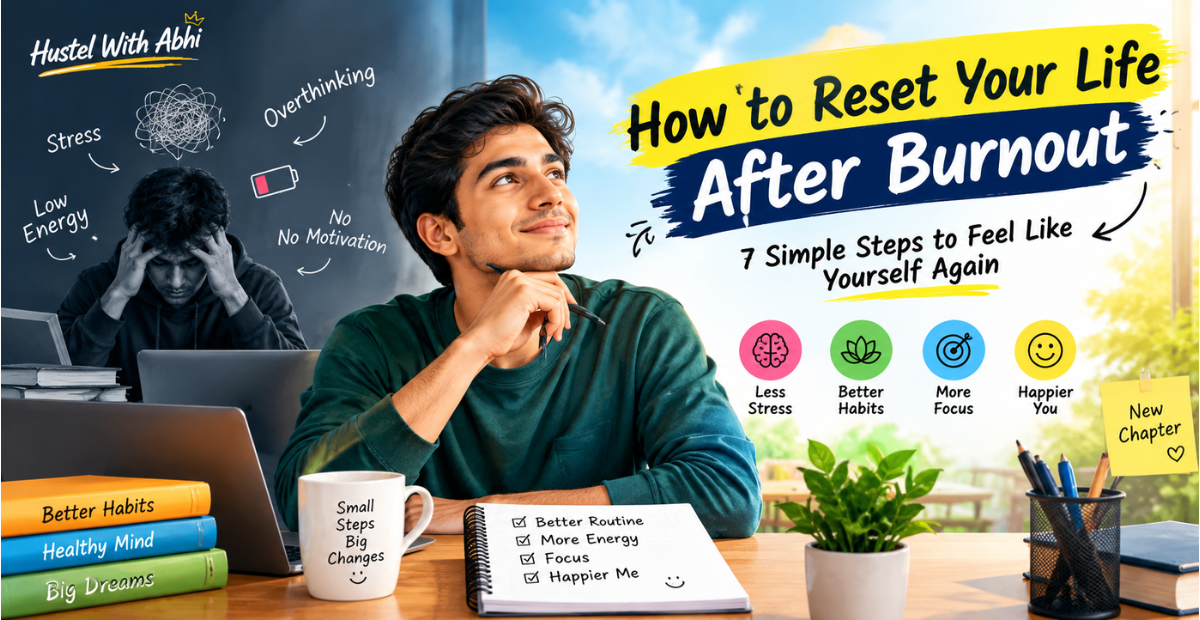
Have you ever reached a point where even simple things feel exhausting? You wake up tired, look at your work or to-do list, and feel like you have no mental energy left to deal with any of it.
I’ve experienced this kind of mental exhaustion myself, and one thing I learned is that trying to “push harder” doesn’t always solve the problem. Sometimes, you need to step back and reset.
If you’re wondering how to reset your life after burnout, start by understanding what is actually draining you instead of blaming yourself for having low motivation.
A real reset is not about changing your entire life overnight. It’s about reducing unnecessary pressure, getting your basic routine back on track, taking proper breaks, and slowly rebuilding your focus and confidence.
In this guide, I’ll share practical lessons, simple habits, and personal experiences that helped me approach burnout differently—without unrealistic productivity hacks or overnight transformations.
1. Understand Why You Feel Burned Out Before Trying to Fix Yourself

The first step in learning how to reset your life after burnout is surprisingly simple: stop blaming yourself long enough to understand what’s actually happening.
Burnout can develop gradually. You may notice that you’re tired all the time, losing motivation, becoming more negative, withdrawing from people, struggling to complete normal tasks, or experiencing changes in sleep and appetite.
The problem is that many of us immediately call ourselves lazy.
“I should work harder.”
“I wasted another day.”
“Why can’t I focus like before?”
I’ve had moments where I thought exactly like this. But one thing I personally noticed was that pushing harder didn’t always make me more productive. Sometimes it only made me more frustrated.
So before creating another productivity plan, ask yourself a few honest questions.
What has been draining me lately?
When did I start feeling this way?
Am I taking on more than I can realistically handle?
Do I have any proper time when I’m not thinking about work, studies, content, or responsibilities?
You don’t need perfect answers.
I personally like writing things down because thoughts become easier to understand once they are outside your head. Even ten minutes of honest journaling can show you patterns that you were ignoring.
And if exhaustion is persistent, severe, or affecting your everyday life, don’t try to diagnose yourself through a blog post. Speaking with a qualified healthcare professional can help you understand what’s really going on.
2. Give Yourself a Real Reset Instead of Creating Another Productivity Challenge
When people hear “reset your life”, they often imagine a dramatic transformation.
Wake up at 5 AM.
Exercise every morning.
Read 50 pages.
Delete social media.
Work for eight hours.
Eat perfectly.
Meditate.
And somehow become a completely new person by Monday.
Honestly, that sounds exhausting just reading it.
If you’re already burnt out, your reset should initially create less pressure, not more.
Start with the basics. Try to maintain a reasonably consistent sleep schedule, eat regular meals, take short breaks, move your body, and create some distance from unnecessary notifications and constant online stimulation.
The NHS recommends identifying the things causing stress, focusing on what you can change, setting boundaries, taking breaks, talking to someone you trust, and making small, manageable changes rather than trying everything at once.
One thing that has helped me is not expecting myself to fix everything in one day.
If I have ten things to do, I ask:
“What actually needs to be done today?”
Then I choose the most important task.
That’s it.
Maybe you also need this reminder: rest is not a reward you have to earn.
Sometimes your mind needs quiet before it can think clearly again.
3. Reduce Your Workload Without Abandoning Your Responsibilities
A life reset doesn’t necessarily mean quitting your job, leaving your studies, or walking away from every responsibility.
Sometimes you don’t need to escape your life.
You need to make your current life more manageable.
Take your responsibilities and separate them into three simple groups: things that must be done now, things that can wait, and things that don’t actually need to be done.
This sounds basic, but when you’re overwhelmed, everything starts looking equally urgent.
For example, imagine you have an important assignment, emails, social media notifications, housework, and a personal project.
Your exhausted brain might say:
“I need to finish everything today.”
Instead, try:
“First I’ll finish the assignment. Then I’ll handle the important email. The rest can wait.”
That small shift can remove a surprising amount of mental pressure.
And if work is the main source of your burnout, look beyond personal discipline. Workplace factors such as excessive workload, long hours, lack of control, unclear expectations, and lack of support can contribute to burnout.
This means the solution isn’t always “become mentally stronger”.
Sometimes the solution is a clearer workload, better boundaries, more realistic deadlines, or a conversation with the person responsible for your workload.
You don’t have to prove your strength by carrying everything.
4. Rebuild Your Energy With Small Habits That You Can Actually Maintain
If you want to know how to recover from burnout, don’t start by building the most impressive routine possible.
Build the smallest routine you can realistically repeat.
This lesson has been important for me.
I used to think that if I wanted better results, I needed to do more. Over time, I started understanding that doing a few important things consistently is much more useful than creating a huge routine that I can’t maintain.
For me, simple habits like journaling, walking, focused work sessions, reducing unnecessary phone use, and taking care of sleep have been more practical than constantly searching for the next productivity hack.
You can start with something as simple as this:
- Keep your sleep and wake times reasonably consistent.
- Take a short walk or do manageable physical activity.
- Work on one important task without constantly switching.
- Keep your phone away for a focused period.
- Spend a few minutes writing down your thoughts.
You don’t need to implement everything tomorrow.
Pick two habits.
Once they become normal, add another.
I especially like focused work sessions because they make large tasks feel smaller. Instead of telling myself, “I have to finish this entire article,” I can say, “I’ll focus for 25 minutes.”
The funny thing is, once you start, continuing often becomes easier.
And if you only have enough energy for a smaller version of your normal routine, that’s okay.
A 20-minute walk is still movement.
300 useful words are still progress.
Ten minutes of journaling is still reflection.
A smaller step is better than constantly waiting for the perfect day.
5. Rebuild Your Confidence by Keeping Small Promises to Yourself
Burnout doesn’t only take away energy.
Sometimes it also damages your trust in yourself.
You start wondering:
“Why can’t I work as I used to?”
“Why am I procrastinating so much?”
“Maybe I’m not disciplined anymore.”
This is where I believe small wins become powerful.
Instead of trying to feel confident first, give yourself small opportunities to prove that you can still take action.
Suppose you planned to write a 1,500-word article but feel completely drained.
Don’t force yourself to finish the entire thing.
Write 200 or 300 useful words.
Then stop if you need to.
The next day, continue.
I’ve learned that progress doesn’t always look impressive from the outside. Sometimes progress is simply opening the document when you didn’t feel like it and doing a small amount of meaningful work.
The same applies to exercise, studying, cleaning your room, or getting back into a routine.
One thing I personally believe is that your mind becomes easier to work with when you stop treating it like an enemy.
Instead of saying, “I have to do this,” I sometimes tell myself, “Let’s just start and see how it goes.”
That small mental shift can make action feel less like punishment.
Trust me, consistency slowly changes everything.
Your goal isn’t to return to your old version overnight.
Your goal is to build a healthier version of yourself at a sustainable pace.
6. Make Sure Your Reset Doesn’t Lead You Back to the Same Burnout

Recovering is important, but prevention matters too.
If you return to exactly the same workload, habits, boundaries, and expectations that exhausted you in the first place, you may eventually find yourself in the same situation again.
This is where an energy audit can help.
Take a piece of paper and make two columns.
What drains me?
Maybe it’s constant notifications, unrealistic deadlines, social comparison, multitasking, poor sleep, saying yes to everything, or working without proper breaks.
What helps me feel better?
Maybe it’s walking, journaling, talking to someone you trust, spending time offline, exercising, reading, sleeping properly, or simply having quiet time.
Look for patterns.
You might discover that your biggest problem isn’t a lack of motivation. Maybe your day is simply overloaded.
You might realise that your phone is interrupting your concentration every few minutes.
Maybe you never properly finish work because notifications continue into the evening.
Maybe you’re trying to achieve too many goals at the same time.
These observations are valuable because a good reset isn’t only about feeling better for a few days. It’s about changing the conditions that keep pushing you towards exhaustion.
Set boundaries where possible. Take breaks. Protect your personal time. Learn to say no when your plate is already full.
And if work is involved, remember that burnout isn’t always something an individual can solve alone. WHO guidance on mental health at work includes organisational changes such as addressing workload, working time, communication, support, and working conditions.
Also, don’t make major life decisions simply because you’re exhausted today. Give yourself some space to think clearly.
If your symptoms continue, become severe, or interfere with your ability to function, professional support is worth considering. Burnout can overlap with other mental health problems, and persistent symptoms deserve proper attention rather than self-diagnosis.
How do I reset my life after burnout?
Start by identifying what's causing your exhaustion, reducing unnecessary pressure, and returning to basic routines such as consistent sleep, regular meals, movement, breaks, and manageable daily goals. Don't try to rebuild your entire life at once.
How can I recover from burnout naturally?
Focus on sustainable habits such as adequate sleep, regular movement, meaningful breaks, realistic workloads, social support, and time away from constant digital stimulation. Recovery also requires addressing the source of ongoing stress rather than only managing the symptoms.
What are the best burnout recovery tips for beginners?
Start small. Reduce unnecessary commitments, protect your sleep, take short walks, limit distractions, use focused work sessions, journal when your mind feels crowded, and talk to someone you trust. You don't need a complicated recovery routine.
How long does it take to recover from burnout?
There is no universal recovery timeline. It depends on the cause, duration, severity, environment, and whether the factors creating the stress can be changed. Recovery is usually a gradual process rather than something that happens on a fixed schedule.
Conclusion
If you’re learning how to reset your life after burnout, remember that you don’t need to rebuild everything overnight.
Start by understanding what is draining you, reduce unnecessary pressure, return to simple habits, and slowly rebuild trust in yourself.
My own experience has taught me that small consistent steps can take you much further than dramatic comebacks.
Start with one manageable change today, and if this helped, explore our other self-improvement blogs, share your experience in the comments, and subscribe for more practical guides.
Read All Our Articles Here: Hustel With Abhi
✨ Join 10k+ readers for free tips!
Subscribe & never miss a post 📩
good tips