
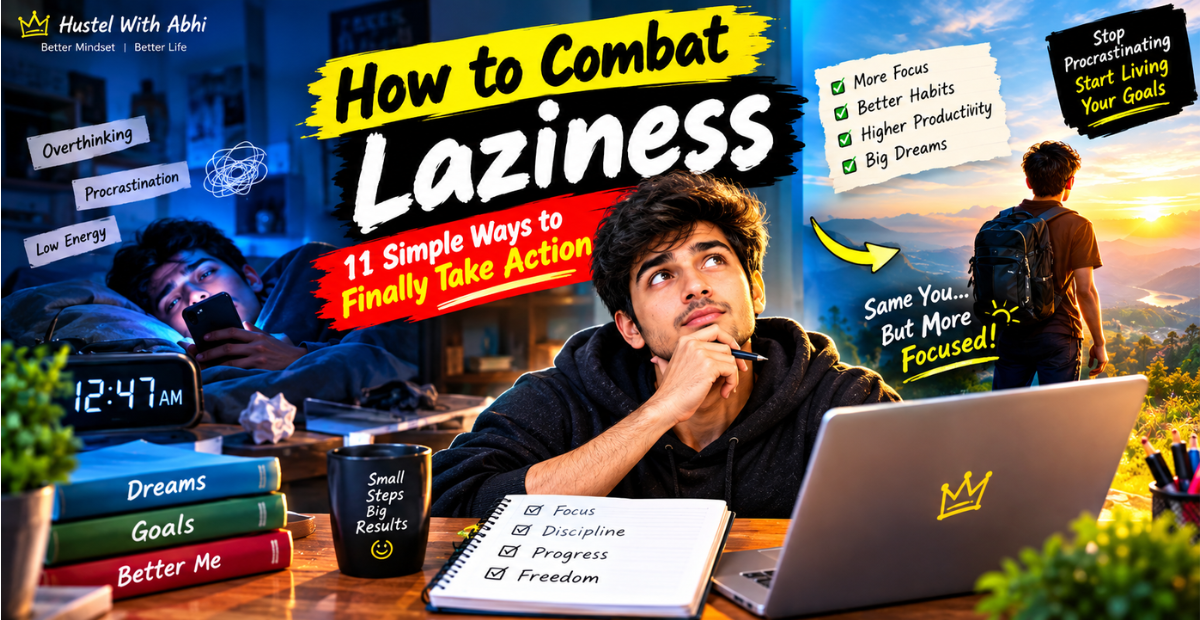
Do you often want to get things done but keep putting them off because you feel lazy or unmotivated? You’re not alone.
If you’re wondering how to combat laziness, the solution isn’t simply to “work harder.” Laziness can come from unclear goals, low energy, distractions, or the habit of avoiding difficult tasks.
In this guide, I’ll share simple, practical ways to combat laziness, get started, and stay consistent—whether you’re a student, working professional, or trying to improve your daily life.
What is laziness really? (And Why You’re Not Actually Lazy)

Let’s clear one thing first.
Most people are not truly lazy.
What we often call laziness is usually a symptom of something deeper.
It can come from poor sleep, emotional overload, fear of failure, unclear goals, or even too much social media consumption.
In simple words, laziness is more about resistance than personality.
Sometimes your brain is not refusing work because you don’t care. It is refusing because the task feels mentally heavy.
That’s a huge difference.
For example, writing “finish entire assignment” on your to-do list can feel overwhelming. But writing “complete first question” may be manageable.
The problem is not that you don’t want to work.
The problem is that the brain sees the task as too big, too unclear, or too exhausting.
That’s why learning how to stop being lazy and unmotivated starts with changing how you see the problem.
Why “I am lazy” is the wrong belief that keeps you stuck
One of the most damaging things you can do is turn a temporary struggle into an identity.
When you keep telling yourself, “I am lazy,” your mind starts accepting it as the truth.
Then every delayed task becomes proof.
This creates a loop:
You avoid work, feel guilty, call yourself lazy – confidence drops – you avoid work again.
I’ve personally experienced this.
In the beginning, I used motivation to start my work. But after some time, I understood that motivation doesn’t stay forever.
Some days, energy is high.
Some days it is low.
Still, the work needs to happen.
That’s where discipline and consistency become more powerful than motivation.
Honestly, this shift changed everything for me.
Now, even on low-energy days, I still show up for my work.
- Not perfectly.
- Just consistently.
- And that matters more.
Why do I feel so lazy all the time? (Hidden Root Causes Explained)
If you often ask yourself, why do I feel lazy all the time, the answer usually lies deeper than “lack of discipline”.
Let’s break down the real reasons.
Mental overload and unclear goals that freeze action
This is one of the biggest hidden causes.
Sometimes the brain is carrying too many open loops.
Unfinished tasks.
Pending deadlines.
Random thoughts.
Pressure from studies or work.
When everything feels scattered, even a simple task starts feeling difficult.
For example, “work on blog” is too vague.
However, “write the first 100 words of the introduction” provides mental clarity.
Clarity reduces resistance.
Confusion increases procrastination.
Emotional resistance (fear, failure, perfection pressure)
Sometimes the problem is not with the task itself.
It is what the task emotionally represents.
Fear of failure.
Fear of judgement.
Fear that your work won’t be good enough.
This happens a lot with students, creators, and professionals.
I’ve had moments where I wanted to start writing but kept delaying because I wanted the article to sound perfect.
The result?
I didn’t start at all.
Perfectionism often wears the mask of laziness.
Physical energy problems (sleep, diet, lifestyle imbalance)
Sometimes what feels like laziness is simply low energy.
If your sleep is poor, water intake is low, meals are irregular, and movement is almost zero, your body naturally slows down.
In such situations, the issue is not motivation.
The issue is recovery.
From my own routine, I noticed a major difference when I started focusing on basics:
Good sleep, enough water, morning sunlight, and short walks.
Even 10–15 minutes of sunlight in the morning genuinely improved my focus.
Dopamine imbalance from social media and instant gratification
This is something most people ignore.
Social media gives instant pleasure.
Quick dopamine.
Fast rewards.
But deep work like studying, writing, or problem-solving gives slow rewards.
That’s why reels feel easier than work.
Your brain naturally chooses the easier reward.
This doesn’t mean you are lazy.
It means your reward system needs balance.
How to Combat Laziness: 9 Practical Strategies That Actually Help
If you truly want to learn how to combat laziness, stop depending on motivation alone.
Use systems that work with your brain.
Start with just 2 minutes
Starting is usually harder than doing.
Once you begin, resistance often drops within 2–5 minutes.
This is why the beginning matters more than the full task.
Tell yourself:
I’ll just do this for two minutes.
Most of the time, those two minutes become twenty.
Break Big Tasks Into Smaller Steps
This method helped me personally.
Instead of writing “complete blog post,” I write:
Write a heading.
or
Write the first 50 words.
The resistance decreases with a smaller start.
This is one of the best ways for how to overcome laziness and procrastination.
How to Overcome Laziness and Procrastination with Daily Systems

Motivation fades.
Systems stay.
3-step momentum system
Use this simple structure:
- 2 minutes to start
- 5 minutes to settle in
- 20 minutes to focus deeply
This works because momentum builds naturally.
I personally use the 25-minute Pomodoro method a lot.
It keeps work realistic.
Environment design (make work easy, distractions difficult)
Your environment shapes behavior.
If the phone is next to you, it becomes the default escape route.
A practical fix that works for me:
I keep my phone switched off and place it inside a drawer during deep work.
I only take it out after the session is complete.
Sometimes I even use a reward system.
For example:
After 2 hours of deep work, I allow myself one episode of a favorite show.
This makes discipline easier.
Trigger-based habits for automatic productivity
Link work to an existing routine.
For example:
after morning tea- open laptop – work for 10 minutes before touching phone
This reduces decision fatigue.
Personally, keeping a simple to-do list in the morning helps me stay clear.
7 Mistakes That Make Laziness Worse
- Waiting for motivation
- Setting too many goals
- Starting with huge tasks
- Keeping your phone nearby
- Ignoring sleep and energy
- Being too hard on yourself
- Giving up after one bad day
This gives the section a much stronger purpose.
Setting unrealistic goals and burning out early
Trying to change everything in one day rarely works.
Waking up at 5 AM, studying 6 hours, working out, blogging daily — all at once — leads to burnout.
Real transformation happens gradually.
This is something I strongly believe from experience.
Take it step by step.
Using self-criticism instead of solution thinking
Calling yourself lazy may create short-term guilt.
But long-term, it damages confidence.
Instead of self-blame, ask:
What is actually stopping me right now?
That question changes everything.
Feeling Lazy Right Now? Try These 5 Quick Fixes
Sometimes you need an immediate reset.
If you feel tired
Drink water.
Take a 5–10 minute walk.
Sit back at your desk.
Often, the body needs activation, not pressure.
If you feel overwhelmed
Break the task into one visible next step.
Instead of “start research.”
write
“Search one keyword.”
If you keep scrolling on your phone
Move the phone to another room for 25 minutes.
Make distraction difficult.
Make work easy.
If you overthink starting
Write a messy first draft.
A bad first draft is better than no draft.
This is one of the biggest lessons I learned in content writing.
How to Stop Being Lazy and Unmotivated Long-Term
The long-term solution is an identity shift.
Identity shift from “lazy person” to “action-based person.”
Don’t focus on labels.
Focus on actions.
Instead of saying, I am productive
prove it through one small daily action.
Actions create identity.
Consistency over intensity
Small daily wins compound.
10 minutes daily beats one intense day followed by six unproductive days.
This is exactly how habits are built.
How to Combat Laziness as a Student
- Study for only 10 minutes initially
- Keep phone away
- Break the syllabus into chapters
- Use 25/5 Pomodoro
- Set a specific study target
Why Laziness Comes Back Even After You Start Improving

This is normal. Sometimes one bad day turns into three.
Then guilt returns.
Then avoidance returns.
The cycle repeats.
The key is restarting quickly.
Don’t wait for Monday.
Restart the same day.
Even 5 minutes of work breaks the cycle.
That is how momentum returns.
Frequently Asked Questions
Why am I always feeling lazy?
The identical question used to cross my mind. In many cases, it’s not about being lazy at all. Sometimes it’s poor sleep, mental stress, or even emotional pressure. There were days when I slept enough but still felt drained because my mind was overloaded.
Is discipline better than motivation?
Motivation comes and goes, and I’ve experienced that many times. The level of energy varies from day to day. But discipline helps you continue even on low-energy days, and that’s what really builds progress.
Conclusion
So, if you truly want to learn how to combat laziness, remember this simple truth: laziness is rarely who you are; it’s usually a signal that something deeper in your routine, energy, or mindset needs attention.
Sometimes the issue is sleep, sometimes overthinking, and sometimes just unclear goals.
In my experience, small daily actions and discipline create real change, not temporary motivation.
Start with one simple step today and let consistency do the magic. If you found this blog genuinely helpful, please do comment and share your experience.
Also, read our other life-improvement blogs because they are written from real experiences and practical solutions.
By subscribing, you will get every new blog directly in your inbox, and you can implement it in your daily life.
If you need a solution on any life-related topic, comment—I’ll write a valuable, experience-based blog to help you out.
Read more articles here: Hustel With Abhi
✨ Join 10k+ readers for free tips!
Subscribe & never miss a post 📩