
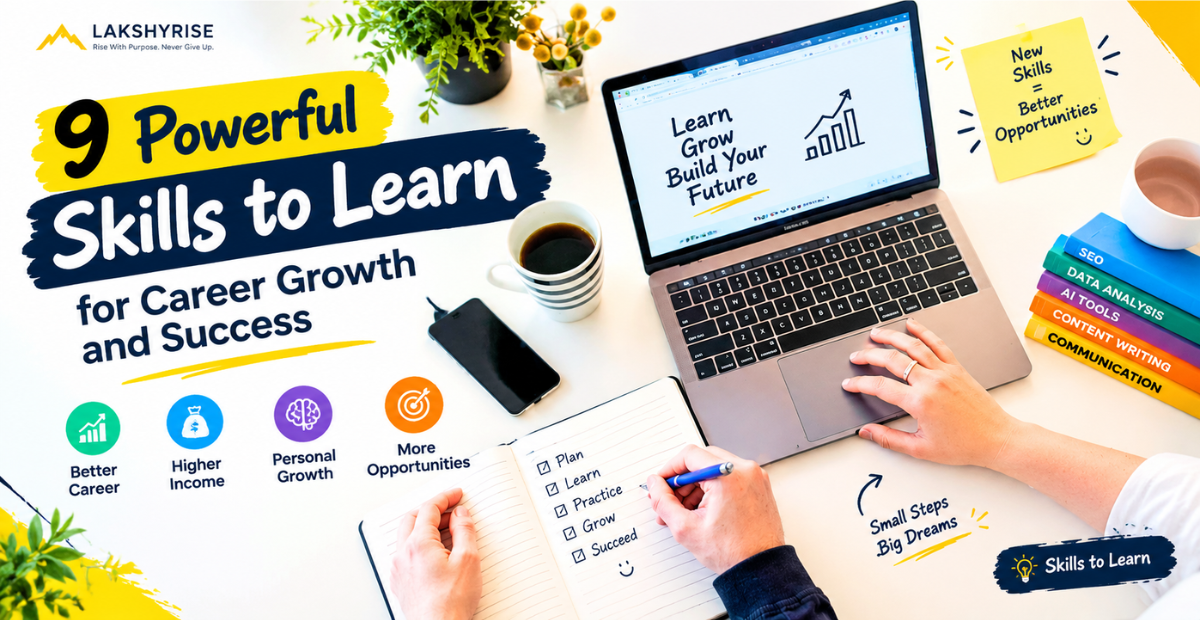
Skills to learn can make a real difference in your career, confidence, and future opportunities. But with so many options available, choosing the right skill can feel confusing. Should you focus on digital marketing, data analysis, AI tools, or something else?
I faced a similar learning journey when I started blogging. I didn’t know much about SEO, keyword research, or backlinks at first. I learned step by step, made mistakes, and improved through practice. That experience taught me that you don’t need to master everything at once to make progress.
In this guide, we’ll explore nine practical skills, how to choose the ones that match your goals, and how to turn what you learn into real-world opportunities. Let’s get started!
1. Digital Marketing and SEO

Digital marketing helps businesses reach the right audience online, while search engine optimisation (SEO) helps websites become more visible in search results.
You can start with keyword research, content optimisation, search intent, internal linking, and understanding website performance. As you improve, you can explore email marketing and social media strategy.
I’m learning and applying SEO through my own blogging journey. Working on blog posts has helped me understand that publishing content is only one part of the process. You also need to understand what readers want and how to make information easy to find.
Try this: create a small blog or optimise an existing article. Research a keyword, improve its headings, and monitor the results.
2. Data Analysis
Data analysis is about turning raw information into useful insights. Businesses use it to understand performance, identify problems, and make better decisions.
Start with Microsoft Excel or Google Sheets. Learn formulas, percentages, sorting, filtering, charts, and basic statistics. Then move to SQL, a visualisation tool such as Power BI, and Python if your career goals require them.
You don’t need to master every tool at once. Build a strong foundation before moving to advanced topics.
Try this: Take a sample sales dataset, calculate total sales, find the best-performing product, and create a simple chart.
3. AI Literacy and Practical AI Tools
Artificial intelligence is becoming part of everyday work. Learning how to use AI tools responsibly can help with research, brainstorming, organising information, and automating repetitive tasks.
However, using AI isn’t just about writing prompts. You also need to check facts, protect confidential information, recognise errors, and use your own judgement.
The World Economic Forum’s Future of Jobs Report 2025 identifies AI and big data among the fastest-growing skill areas through 2030.
Try this: Use an AI tool to outline a project, verify its suggestions independently, and improve the final result yourself.
4. Content Writing and Copywriting
Good writing helps you explain ideas clearly, build trust, and communicate with an audience. Content writing focuses on useful material such as blog posts and guides, while copywriting aims to encourage a specific action.
I learned that writing becomes more effective when you focus on the reader instead of simply trying to fill a page. A useful article should answer real questions, provide practical advice, and avoid unnecessary repetition.
Try this: Write a 500-word article about a topic you understand. Edit it for clarity, remove repeated ideas, and ask someone for feedback.
5. Communication and Public Speaking
Technical knowledge is valuable, but you also need to explain your ideas so other people can understand them.
Communication includes writing clear emails, asking questions, listening carefully, explaining problems, and presenting information confidently. These abilities are useful in almost every profession.
You don’t have to become an outstanding public speaker overnight. Start by explaining one concept in simple language or recording a short presentation.
Try this: Choose a topic you know well and explain it in two minutes without reading directly from a script.
6. Critical Thinking and Problem-Solving
Critical thinking means examining information carefully instead of accepting every claim immediately. Problem-solving involves identifying the cause of an issue and testing possible solutions.
These abilities are particularly useful when working with data, evaluating business decisions, researching information, or using AI-generated answers.
The World Economic Forum also identifies analytical thinking as a leading core skill for employers in its 2025 report.
Try this: Whenever you face a problem, write down what you know, identify what is missing, compare possible solutions, and explain why you chose one.
7. Graphic Design and Visual Communication
Businesses, bloggers, and creators need visuals that communicate information clearly. Basic graphic design can help you create blog graphics, presentations, social media posts, and simple marketing materials.
Beginners can explore Canva before moving to more advanced design software. Focus first on readable text, spacing, contrast, alignment, and visual hierarchy.
Try this: Design three social media graphics for an imaginary business. Keep the message clear and use consistent fonts and colours.
8. Financial Literacy
Financial literacy helps you understand budgeting, saving, debt, interest, and the difference between needs and wants. It also helps you make more informed decisions about money.
You don’t need to become a financial expert. Start by tracking your expenses, creating a monthly budget, and understanding how compound interest works.
Try this: Record your spending for 30 days and identify one realistic way to save money without compromising essential needs.
9. Time Management and Consistent Learning

Learning a valuable skill takes time, and poor planning can make the process harder than it needs to be.
I made a similar mistake during my school days. I was good at studying, but I didn’t always study regularly. When exams approached, I tried to cover too many subjects at once. It became difficult to concentrate properly.
Over time, I realised that focusing on one task at a time and practising consistently makes learning more manageable. The same lesson applies to building professional skills.
Try this: Set aside 30 minutes each day for one skill. Choose a small task, complete it, and record what you learned.
Which Skills Should You Choose First?
The best skills to learn depend on your interests, existing abilities, and career goals. You don’t need to learn all nine at once.
Here are a few practical combinations:
- For aspiring data analysts: Excel, SQL, statistics, and data visualisation.
- For bloggers and creators: SEO, content writing, communication, and basic design.
- For students and beginners: Communication, spreadsheets, AI literacy, and time management.
- For aspiring freelancers: Choose one marketable service, build a portfolio, and learn how to communicate with clients.
When researching high-income skills to learn, remember that no skill guarantees a particular salary. Earnings depend on your proficiency, experience, location, portfolio, and the value you deliver to clients or employers.
How to Start Learning a Skill Without Getting Overwhelmed
Follow this simple process:
- Choose one skill: Pick something connected to a clear personal or career goal.
- Find reliable resources: Use tutorials, structured courses, documentation, and trusted learning platforms.
- Practice every day: Spend 30–60 minutes learning and applying what you’ve learned.
- Build a small project: Create something you can show instead of collecting certificates alone.
- Review your progress: Identify mistakes, request feedback, and improve your work.
One mistake I made while learning was expecting results too quickly. Content writing and blogging didn’t produce the outcomes I wanted immediately. Instead of treating slow progress as failure, I continued learning and improving my work.
That experience is why I recommend measuring progress through completed projects and improved abilities, not just the number of courses you finish.
Frequently Asked Questions
Which skills can help you earn more money?
SEO, data analysis, software development, digital marketing, and copywriting can lead to paid opportunities. However, income is never guaranteed, and practical experience matters.
Can I learn a new skill for free?
Yes. You can begin with free tutorials, documentation, practice datasets, and personal projects. Paid courses are optional when free resources meet your needs.
How long does it take to learn a new skill?
Basic knowledge may take a few weeks, while professional proficiency can require months or years of practice. Your progress depends on the skill, your starting point, and how consistently you practice.
Conclusion
The most valuable skills to learn aren’t necessarily the most popular ones. They’re the skills that help you solve problems, create something useful, and move closer to your goals.
My blogging journey has taught me that progress comes from learning, making mistakes, and improving through practice. You don’t need to wait until you feel completely ready.
Choose one skill, start with a small project, and keep going. Your first step doesn’t have to be perfect; it just has to happen.
Read our self-improvement article here: Hustel With Abhi
✨ Join 10k+ readers for free tips!
Subscribe & never miss a post 📩
1 thought on “9 Powerful Skills to Learn for Career Growth and Success”